
How Vehicle Active Safety Monitoring Systems Reduce Driving Risks Through ADAS and DMS
The vehicle active safety system uses ADAS, DMS, BSD, driver facial recognition, GPS positioning, and in-vehicle video recording to identify risks such as lane departure, front-end collisions, drowsy driving, driver distraction, phone use while driving, and blind spots. The system not only alerts drivers in real time inside the vehicle but also uploads alert images, short videos, and vehicle locations to the management platform, helping transportation companies establish a closed-loop safety management process—from risk detection to incident resolution.
Updated 11/3/2026
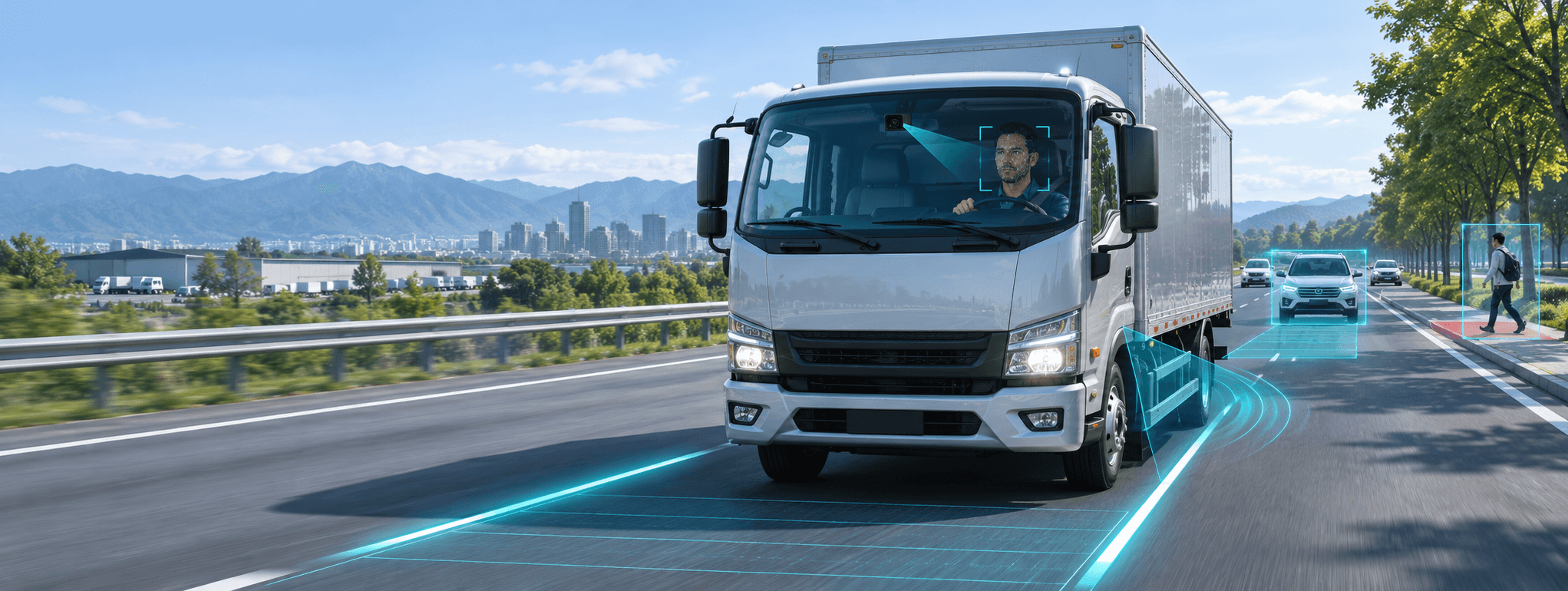
How Vehicle Active Safety Monitoring Systems Reduce Driving Risks Through ADAS and DMS
The primary function of traditional in-vehicle video recorders is to store video footage; typically, managers only review the recordings to investigate the cause of an accident after it has occurred. In contrast, the vehicle active safety monitoring system shifts safety management to the driving process itself. Using cameras, AI algorithms, satellite positioning, 4G communication, and an in-vehicle video recorder, it identifies road hazards and dangerous driving behaviors in real time.
For buses, school buses, logistics trucks, hazardous materials transport vehicles, and construction vehicles, active safety systems not only alert drivers to correct their actions in a timely manner but also enable fleet managers to understand what risks arose, when, and where.
ADAS monitors the road ahead of the vehicle
ADAS (Advanced Driver Assistance Systems) primarily use a forward-facing camera to analyze the road conditions ahead of the vehicle. While the vehicle is in motion, the system can detect lane markings, vehicles ahead, pedestrians, non-motorized vehicles, and certain road signs.
When the system detects that a vehicle is at risk of the following situations, it can issue a voice alert:
- The vehicle unintentionally drifts out of its current lane;
- Following too closely;
- There is a risk of a collision with the vehicle ahead;
- A pedestrian or non-motorized vehicle appears ahead on the road;
- Identifies road signs that require the driver’s attention.
For example, when a long-haul truck driver’s attention wanders on the highway and the vehicle begins to drift out of its lane, ADAS can issue an alert before the danger escalates. It cannot replace the driver’s control of the vehicle, but it can provide an opportunity to detect risks in a timely manner.
DMS monitors the driver’s actual condition
Many traffic accidents are not caused by vehicle malfunctions, but are related to fatigue, distraction, and unsafe driving behaviors. The DMS (Driver Monitoring System) analyzes the driver’s facial expressions and behavior using a camera installed in the cab.
Risks that the system can identify include:
- Keeping your eyes closed for long periods, drowsiness, and frequent yawning;
- The driver’s attention is diverted from the road ahead;
- Using a cell phone or making calls while driving;
- Smoking while driving;
- Other abnormal behaviors that may affect driving safety.
Upon detecting a risk, the device can play a voice alert inside the vehicle while simultaneously generating an alarm log. Fleet managers do not need to spend long periods monitoring real-time video from each vehicle; instead, they can focus on addressing hazardous incidents flagged by the system.
BSD Reduces Blind Spot Risks for Large Vehicles
Buses, trucks, tanker trucks, and construction vehicles have long bodies, making it difficult for drivers to fully see both sides of the vehicle through their rearview mirrors. When pedestrians, electric bikes, or small vehicles enter these blind spots, collisions are likely to occur while turning or changing lanes.
Once the BSD blind spot detection feature is configured, the system can use side-view cameras to identify objects in blind spots and configure alerts based on specific project settings. BSD is an optional feature that requires compatible cameras, algorithms, and proper installation and calibration.
Alarms should not only serve as a warning but also provide evidence.
An effective active safety system must not only emit an audible alert inside the vehicle but also preserve complete evidence of the alert. The MDR820X in-vehicle video unit supports up to 8 channels of 1080P AHD camera inputs, providing coverage of the vehicle’s front, driver’s compartment, doors, cargo area, rear, and both sides.
When an alarm is triggered by ADAS, DMS, or vehicle I/O signals, the system can save alarm images and short videos and upload them to the server via a 4G network. Managers can determine the cause of the incident by reviewing the alarm time, vehicle location, speed, and on-site video footage. Alarm data can also be forwarded via email based on platform settings, allowing responsible personnel to address the issue promptly.
H.265 video encoding reduces network traffic and storage usage while maintaining the same video quality. The device supports storage on SD cards and 2.5-inch hard drives, allowing recordings to be saved locally even when the vehicle is temporarily out of mobile network coverage.
GPS and G-sensor data supplement vehicle operation information
Active safety alerts must be combined with vehicle location and operating status to create a complete record. The device supports GPS and BeiDou positioning, recording vehicle location, speed, and travel routes, with optional GLONASS or RTK positioning available.
The built-in three-axis G-sensor detects abnormal acceleration events such as collisions and rollovers, triggering the in-vehicle unit to take still photos, record video, and upload the data. Following an accident or severe collision, managers can simultaneously view the vehicle’s location, the time the alarm was triggered, and live footage from multiple cameras.
From a Single Alarm to Fleet Safety Management
Installing active safety devices is just the first step; the real value lies in establishing long-term management processes. Companies can use the platform to track the number of alerts for different vehicles and drivers and analyze behaviors such as drowsy driving, lane departure, cell phone use, and following too closely.
For occasional alerts, managers can issue reminders; for drivers who frequently encounter similar risks, targeted training can be arranged; and if alerts occur frequently on a particular route, further checks can be conducted to determine whether road conditions, scheduling, and transportation plans are appropriate.
In this way, vehicle video systems are no longer merely tools for recording footage after an accident; they are gradually becoming an integral part of driving risk identification, incident evidence collection, and fleet safety management.
Which vehicles is this suitable for?
The MDR820X Active Safety In-Vehicle Video System can be used for:
- City buses and intercity passenger vehicles;
- School buses and student shuttle vehicles;
- Logistics trucks and long-haul transport vehicles;
- Tanker trucks and hazardous materials transport vehicles;
- Sanitation trucks, dump trucks, and construction machinery;
- Taxis, ride-hailing vehicles, and commuter vehicles;
- Police, fire, and other specialty vehicles.
The number of cameras and AI features required vary depending on the vehicle type. Before implementing the project, you should confirm the camera installation locations, 4G network bands, data retention period, alert types, and how the system will integrate with the management platform.
Frequently Asked Questions
Can active safety systems take over vehicle control from the driver?
No. This system is primarily used for risk identification, driver alerts, remote management, and incident evidence collection; it cannot replace the driver in braking, steering, or other driving operations.
Do ADAS and DMS use the same camera?
Generally, no. ADAS uses a forward-facing camera, while DMS uses a driver-facing camera. The installation locations and calibration requirements for these two types of cameras are different.
Can the vehicle still record video when there is no 4G signal?
Yes. Videos can be saved to an SD card or hard drive. Remote viewing and alarm uploads require an internet connection; once the vehicle regains internet connectivity, it will continue to transmit relevant data based on the platform and device configuration.
What is the maximum number of cameras that can be connected?
The MDR820X supports up to 8 AHD camera inputs, with each channel supporting up to 1080p resolution. Depending on the vehicle model, it can cover the front, cab, doors, cargo area, rear, and both sides of the vehicle.
Can it be integrated with the customer’s own management platform?
The devices support protocols such as JT/T 808, JT/T 1076, and GB 28181. Whether they can be directly integrated into a customer’s existing platform depends on the platform’s APIs, alarm data, and video transmission requirements.