
How Global IoT Data Plans Keep GPS Trackers Connected Across Borders
A GPS tracker may function normally in one country but suddenly go offline after a vehicle crosses a border. In many cases, this is not due to a device malfunction, but rather because the original SIM card cannot connect to the local mobile network. Global IoT data SIM cards allow compatible GPS trackers to access supported carrier networks in multiple countries and regions, making them ideal for cross-border logistics, international fleets, container tracking, construction equipment, and mobile asset tracking.
Updated 11/4/2026
How Global IoT Data Plans Keep GPS Trackers Connected Across Borders
Cross-border GPS tracking may not sound complicated, but problems often arise once a vehicle actually crosses the border.
The GPS tracker may still be able to receive satellite signals and know its location, but because the SIM card cannot connect to the local cellular network, the location data cannot be transmitted to the server, so the platform still displays a location from several hours ago.
In such cases, the device isn’t necessarily broken; the problem usually lies with the communication network.
Global IoT data SIM cards are designed to solve these kinds of cross-border connectivity issues. Businesses do not need to procure different SIM cards for each country; as long as the tracker’s communication module is compatible with the local frequency bands, data can be uploaded via the networks of supported partner carriers.
GPS positioning and traffic communication are not the same thing.
Many customers confuse GPS signals with SIM card signals, but these are actually two separate systems.
The GPS or GNSS module is responsible for receiving satellite signals and calculating the location, while the SIM card connects to the mobile network and transmits the location data to the server.
The normal positioning process is as follows:
- The tracker receives signals from GPS or BeiDou satellites;
- The device calculates the current latitude and longitude;
- The SIM card connects to available mobile networks;
- The tracker sends location and status data to the server;
- Users can view vehicle locations on a computer or mobile phone.
Therefore, a device may have been successfully located, but because there is no cellular network, the platform still displays it as offline. Global IoT SIM cards improve data transmission but do not directly enhance GPS positioning accuracy.
Why Standard Local Data SIM Cards Are Not Suitable for Cross-Border Projects
Local SIM cards are typically intended primarily for domestic users. While they work fine for domestic fleets, issues such as inability to roam, excessive charges, or network incompatibility may arise once vehicles, containers, or equipment cross into other countries.
Frequently asked questions include:
- Unable to connect to a local carrier after leaving the home country;
- You have to switch SIM cards every time you visit a new country;
- Different carriers require different APN settings;
- Requires management of multiple carrier accounts and top-up platforms;
- Existing 2G or 3G devices are not compatible with the local network;
- International roaming charges lack transparency and are difficult to manage consistently.
Global IoT data SIM cards cannot solve every problem, but they can reduce the workload associated with swapping SIM cards, opening new accounts, and managing different carriers, making them better suited for bulk deployment and long-term operations.
Cross-border freight and international fleets
Cross-border freight is one of the most common applications for global IoT SIM cards.
For example, when a truck needs to travel through multiple countries consecutively, fleet managers want to be able to view the vehicle’s location, route, ignition status, speeding alerts, and unusual stops at any time.
If the SIM card cannot connect to the internet after the vehicle crosses a border, the platform will display the last known location. Even if the tracker has offline storage capabilities, managers can only view the uploaded data once the device reconnects to the internet; they cannot determine the vehicle’s real-time status at that moment.
When used with a compatible global IoT SIM card, the tracker can attempt to connect to the networks of supporting partner carriers in the countries along the route, reducing extended periods of offline status caused by cross-border network switching.
These data SIM cards are suitable for:
- International road freight;
- Cross-border cold chain transportation;
- Tanker trucks and fuel delivery vehicles;
- Long-distance passenger vehicles;
- Cross-border rental vehicles;
- Fleets in Africa, Europe, Asia, and Latin America.
However, “global coverage” does not mean that there is a signal on every road. Mountainous areas, underground parking garages, metal warehouses, remote areas, and carrier coverage dead zones may still affect device connectivity.
Container and Mobile Asset Tracking
Containers, generators, construction equipment, and other mobile assets are frequently shipped to different countries.
If you have to disassemble the device and replace the SIM card every time it’s transferred, it’s not only a hassle but could also compromise the device’s waterproofing. By using a global IoT data SIM card, the same tracking device can remain in use throughout the entire transportation process, eliminating the need for frequent disassembly and SIM card replacement.
It is important to note that global IoT SIM cards connect to terrestrial mobile communication networks, not satellite communication networks.
When containers are far from the coast and in waters without cellular network coverage, standard IoT SIM cards cannot upload data in real time. A reasonable approach is to have the tracking device first store the location data locally and then upload the historical data to the server once the device re-enters a mobile network coverage area.
Selling GPS trackers to international customers
For GPS tracker manufacturers and exporters, offering global IoT SIM cards can also make it easier for customers to test their products.
If a customer purchases a prototype, they would have to contact a local carrier themselves, apply for an IoT SIM card, verify the APN, and select a plan, which would extend the entire testing cycle.
By providing GPS trackers along with international IoT SIM cards, customers can begin testing more quickly once they receive the devices. This approach is particularly well-suited for:
- GPS tracker samples;
- Project validation involving one to five units;
- OEM and ODM custom products;
- Product demonstrations for overseas distributors;
- Temporary Vehicle Tracking Project;
- Equipment sold in multiple countries.
For large-volume projects, it is still necessary to confirm in advance the countries of use, estimated quantity, monthly data usage, and device communication standards; orders cannot be placed solely based on the term “global SIM card.”
What questions should you confirm before use?
1. Device Frequency Bands
The tracking device must support the communication frequency bands used in the destination country. SIM cards can only provide network services; they cannot enable incompatible communication modules to support new frequency bands.
2. Network Standards
Please confirm whether the devices use 2G, 4G LTE Cat-1, LTE-M, NB-IoT, or other networks. The network standards supported vary by country.
3. APN Settings
Some IoT SIM cards require a dedicated APN to be configured. This can typically be done remotely via SMS commands, a USB configuration tool, a Bluetooth app, or a platform, depending on the tracker model.
4. Traffic Requirements
Standard GPS trackers typically use very little data each month, but 4G video surveillance devices consume significantly more data. GPS tracking cards and video surveillance devices cannot be estimated using the same data usage method.
5. Actual Routes Traveled
For cross-border fleets, it is not enough to check only the country of departure and the destination; you must also list all countries traversed along the route and verify the supported carriers and network standards for each one.
6. Field Testing
Carrier coverage information is for reference only. Actual signal strength in warehouses, mountainous areas, mining sites, underground parking garages, and on remote roads should ideally be verified through on-site testing with a prototype device.
A more reliable deployment method
For international GPS projects, it is not recommended to activate several hundred SIM cards right from the start. A more prudent approach is:
- Confirm the GPS tracker model and communication module;
- Please specify the countries and regions where the service will be used;
- Check local carriers, network standards, and device frequency bands;
- Configure the correct APN, server address, and port;
- Start by installing one to five test devices;
- Tested using actual routes;
- Check online status, missed uploads, and data usage;
- Deploy in bulk once stability has been verified.
This allows you to identify any issues with frequency bands, APNs, data plans, or local coverage before making a formal purchase.
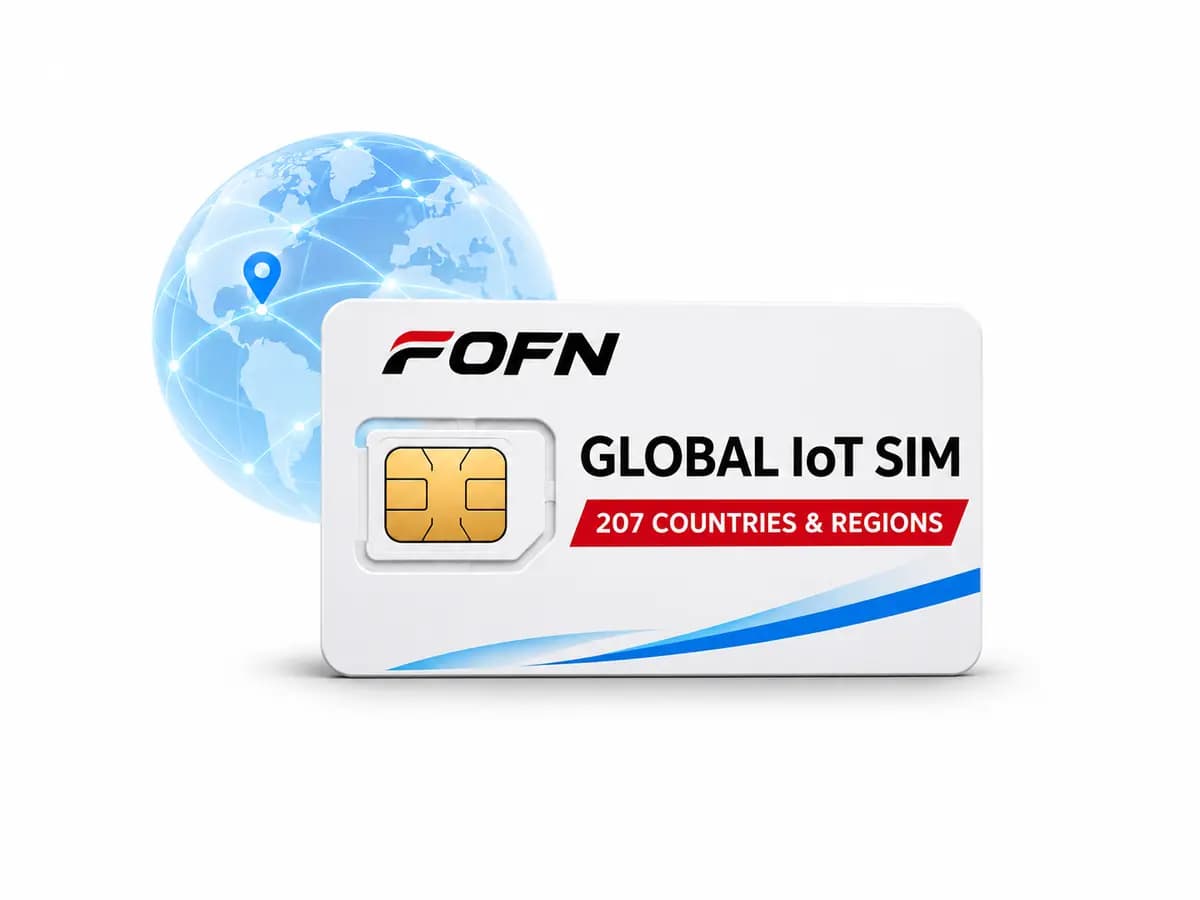
FOFN Global IoT Data SIM Cards
FOFN provides global IoT connectivity services for GPS positioning, fleet management, and mobile asset monitoring projects. Based on the current list of supported countries and carriers, service plans cover up to 207 countries and regions.
This data SIM card can be used with compatible vehicle trackers, asset trackers, logistics devices, and other IoT terminals. FOFN can also assist customers in determining device frequency bands, APN configurations, platform communication methods, and estimated data usage.
Before requesting a quote, we recommend providing the tracker model, communication module, application scenario, country of use, and estimated quantity. This allows us to verify network compatibility based on actual project requirements, rather than relying solely on vague claims of “global availability.”
Frequently Asked Questions
Can the global IoT data SIM card be used in every country?
The FOFN Global IoT Data Plan supports up to 207 countries and regions, but actual service availability depends on the selected plan, partner carriers, local signal strength, roaming agreements, and device frequency bands. Please verify the specific list of supported countries before deployment.
Can this card be installed in any GPS tracker?
Not necessarily. The tracker must have a compatible SIM card slot, communication module, and network frequency bands, and the APN, server address, and port must be configured correctly.
Can using a global IoT SIM card improve GPS positioning accuracy?
No. Positioning accuracy depends primarily on the GPS or GNSS module, the antenna, and the satellite environment. The SIM card’s role is to transmit the positioning data to the server.
Are global IoT SIM cards suitable for tracking cross-border trucks?
Suitable. It can be used for cross-border trucks traveling through multiple supported countries, but the full route—including all countries and regions along the way—must be confirmed in advance.
Are global IoT SIM cards the same as satellite communication SIM cards?
It’s different. Global IoT SIM cards communicate via terrestrial mobile carrier networks and cannot upload data normally when there is no cellular coverage. Real-time communication at sea and in extremely remote areas requires dedicated satellite equipment and satellite services.